
Recruiters spend only a few seconds on a first pass through a resume, and many companies run it through applicant tracking software (ATS) before a human sees it. A resume that gets noticed has to work for both. Here’s how to build one, step by step.
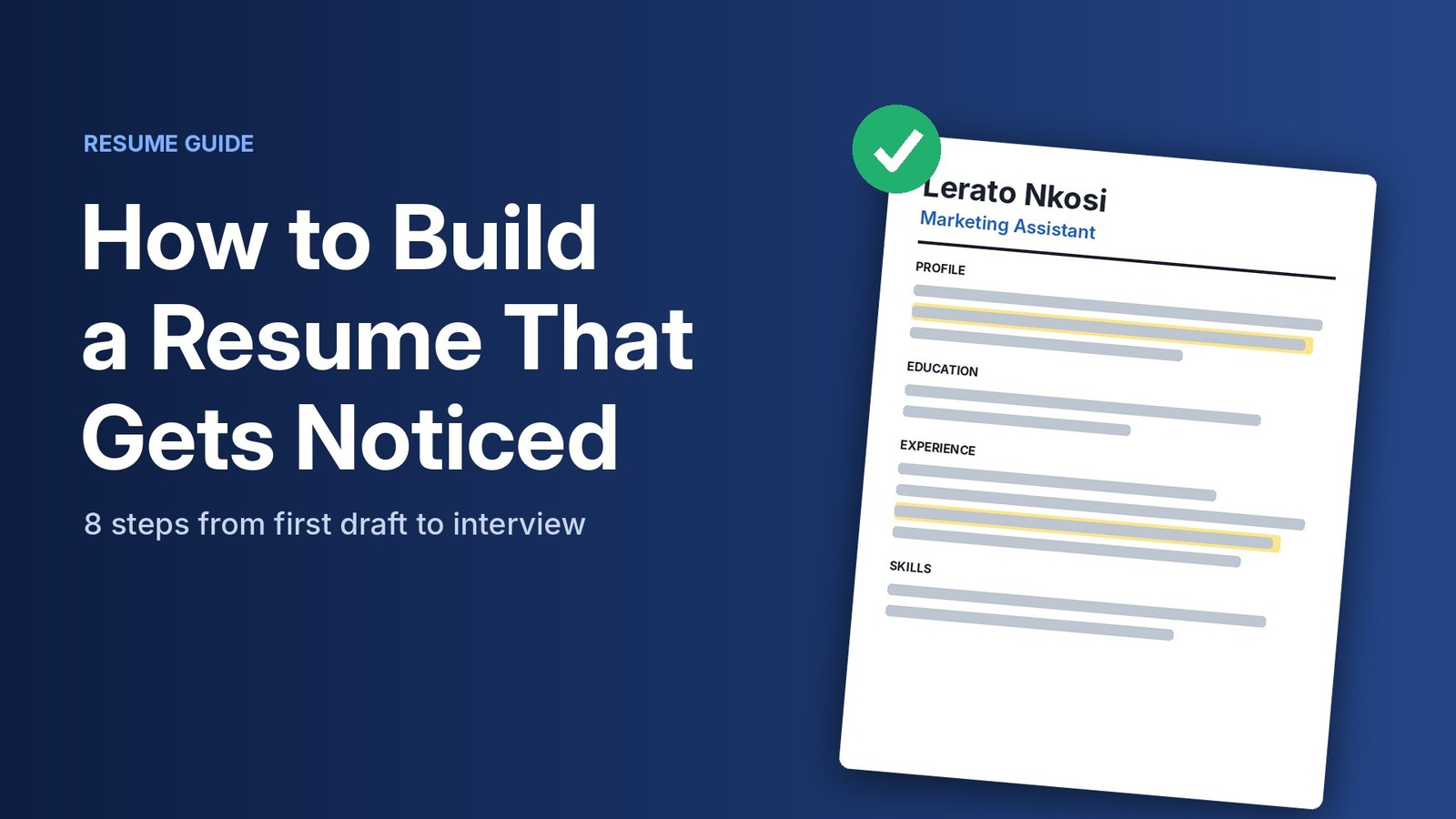
Annotated Resume Example
An entry-level resume for a fictional recent graduate, with each choice explained beside it. No long work history needed: internships, projects and volunteering carry it.
Sample job posting it was written for
Marketing Assistant (entry level), Pretoria. Support the team with social media posts, content creation in Canva, basic Google Analytics reporting, Excel tracking sheets and clear written communication.
Lerato Nkosi
Marketing Assistant
Pretoria, Gauteng | 071 000 0000 | lerato.nkosi@example.com | linkedin.com/in/lerato-nkosi-sample
Profile
Marketing graduate with a 6-month agency internship and hands-on experience in social media, content creation and Google Analytics. Grew a student society’s Instagram following by 140% in one semester. Keen to support a busy marketing team.
Aim at one job title
“Marketing Assistant” matches the posting. Even with no full-time job, a clear target tells the reader where you fit.
Simple one-page layout
Single column, one font, no photo, no icons. At entry level, one page is the rule.
A profile built on proof
Lead with your degree, your best experience and one number. Skip “hardworking and passionate”.
Education
Final-year average: 72%. Marketing Research project awarded 80%. Dean’s list 2024.
Education goes first
For recent graduates, your degree is your strongest credential, so it sits above experience. Move it lower once you have two or more years of work.
Experience
- Created and scheduled 30+ social media posts a month in Canva across 4 client accounts.
- Built an Excel tracking sheet that cut weekly reporting time from 3 hours to 1.
- Pulled Google Analytics data for a monthly client report that helped win a 12-month contract renewal.
- Served 40+ customers per shift and met monthly sales targets in 8 of 10 months.
Small jobs count
Internships and part-time work show reliability. Describe each with a result, even a small one: what you did + a number.
Projects and volunteering
- Planned weekly content creation and grew Instagram followers from 800 to 1,920 in one semester.
- Wrote a full marketing plan and budget for a local coffee brand, presented to a panel of 3 lecturers.
Fill gaps with projects
Society roles, class projects and volunteering prove skills employers want. Use the posting’s words where true: press the highlight button to see them.
Skills
Marketing: Social media planning, content creation, copywriting, market research
Tools: Canva, Google Analytics (certified), Excel, Meta Business Suite
Languages: English, Sesotho, isiZulu
Skills you can prove
List only skills linked to an example above. Certificates, such as a free Google Analytics course, add weight.
Certifications
Google Analytics Certification (2025) | Hootsuite Social Marketing Certification (2025)
Leave out the filler
No age, ID number, photo or “references available on request”. Short, relevant and error-free beats long.
Proofread, then save as PDF
Read it aloud and check every date. Save as Lerato-Nkosi-Resume.pdf unless the employer asks for Word.
No experience yet?
Start with the projects section: class work, volunteering, personal blogs and online courses all show initiative. Tailor the keywords for every application.
1. Start With a Target Role
Pick one job title you’re aiming for. Collect three to five postings for it and note the skills, tools and keywords that keep appearing. A resume written for a specific role beats a generic one every time.
2. Choose a Clean, Simple Format
Stick to a single-column, reverse-chronological layout with one readable font (Calibri or Arial at 10-12pt) and clear section headings. Avoid tables, text boxes, icons and photos, because ATS software often misreads them. Keep it to one page, or two if you have more than ten years of experience.
3. Write a Sharp Header and Summary
At the top, include your name, city, phone number, a professional email address and your LinkedIn profile. Follow it with a two to three line summary covering your job title, years of experience, strongest skills and the kind of results you deliver. Skip filler like “hard-working team player.”
4. Lead With Achievements, Not Duties
Anyone can list responsibilities. What sets you apart is results. For each role, write three to five bullets that start with a strong action verb and end with a measurable outcome.
- Weak: Responsible for customer service.
- Strong: Resolved 40+ customer queries daily, lifting satisfaction scores from 82% to 94%.
Use numbers, percentages, budgets, team sizes and timeframes wherever you honestly can.
5. Mirror the Job Posting’s Keywords
Work the exact terms from the job ad into your summary, skills section and bullets, but only where they’re true. This helps you pass ATS filters and shows the recruiter at a glance that you fit the role.
6. Add a Focused Skills and Education Section
List your most relevant skills in a compact block, grouped by type (for example, software, technical skills, languages). Put education, certifications and training below. Recent graduates can move education higher.
7. Cut Ruthlessly
Remove anything that doesn’t support your target role: jobs older than 10-15 years, outdated skills, “references available on request,” and personal details like age or marital status. Every line should earn its place.
8. Proofread, Test and Save Correctly
Read the resume aloud, run a spell check and ask a friend to review it. Make sure dates, titles and contact details are consistent. Save it as a PDF (unless the employer asks for Word) with a clear filename such as FirstName-LastName-Resume.pdf. Then paste it into a plain text file to confirm nothing scrambles.
Final Thoughts
A standout resume is clear, targeted and full of proof. Tailor it for each application, keep your achievements front and centre, and update it regularly so you’re always ready when the right opportunity appears.
